The double glazing and air-conditioning efficiently kept out the street noise and the room at a comfortable temperature, and we both slept well. Breakfast was served from seven, very unusual for Spain, I was expecting a basic tostada and coffee affair but it exceeded my expectations, with fruit, wholemeal bread, toppings and pastries. We called in to a Dia supermarket and were soon away on the Val de Zafan via verde.
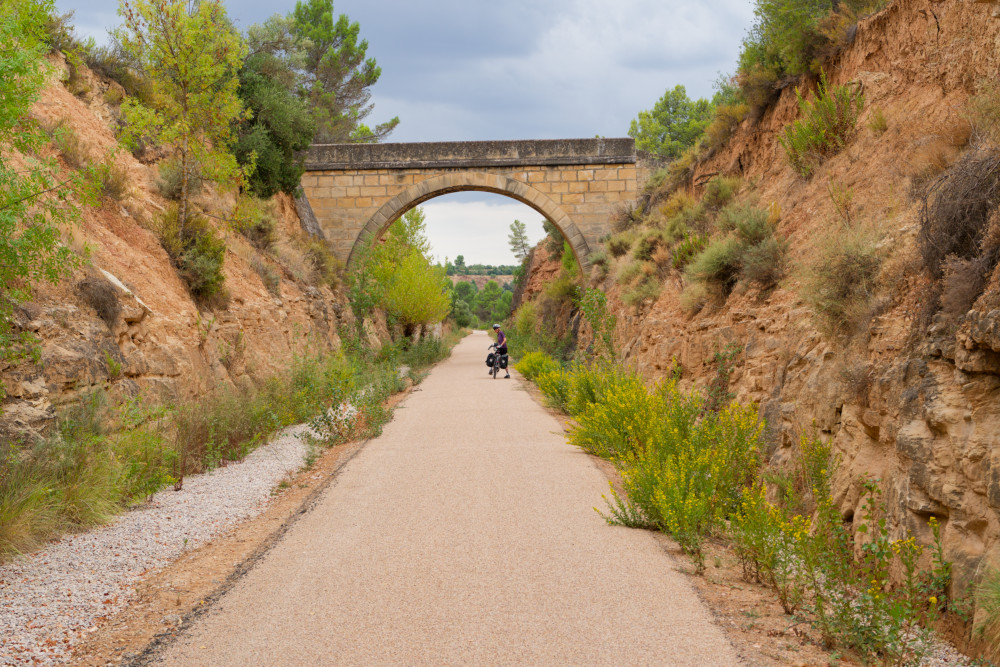
The surface was better than we’d encountered on the Santander-Mediterráneo but at Valdealgorfa it changed to big rocks that were beyond the capability of our touring bikes. We investigated how far this continued, it carried on into a 3km long unlit tunnel. With no indication of when a better surface would prevail, we consulted the map and took a hilly detour, first up to a junction where I had a refreshing copa of Mahou Radler and Christine a large mineral water, the remains of which topped up our bottles. We later learned that this section was officially closed, storm rainwater had washed away the fence blocking access.
Here we took the N420, which was not at all busy, and turned off on a minor road which crossed the trail. This turned out to be not on the same level, and there was no easy way to access it. We returned to the main road as far as Valdeltormo where a sign at the start of a dead end road told us the old station and the trail were 2.2km away, not far but up some steep hills.
A neglected picnic area by the station was the setting for our late lunch. The via verde surface had been paved, as shown on OpenStreetMap but not maintained, still better than we’d found further north. The weather was cloudy, hot and humid, and soon we heard distant thunder. Then dampness in the air and very light refreshing rain. The downpour arrived as we rode into Cretas and through its narrow streets to our hotel.
“Cretas, also known as Queretes in Catalan, is a small town located in the Matarraña region, in the province of Teruel, Spain. This charming village, with a population of just 600 inhabitants, is a true hidden treasure in the Aragon region. The historical heritage of Cretas is one of its main attractions. The old town is full of buildings of great architectural value, such as the Parish Church of the Assumption, an impressive Gothic-Renaissance style building from the 16th century, and the Hermitage of Santa Ana, a small jewel of popular architecture from the 18th century. It is also worth visiting the Portal de Maella, an old entrance gate to the village that still retains its medieval structure.”
We were able to look round before dinner, there’s no restaurant at the hotel, and the only place to eat is Centro Cultural which serves food from 20:00. They do tapas, several of which are vegetarian so we are well, our first acceptable meal out in Spain.